
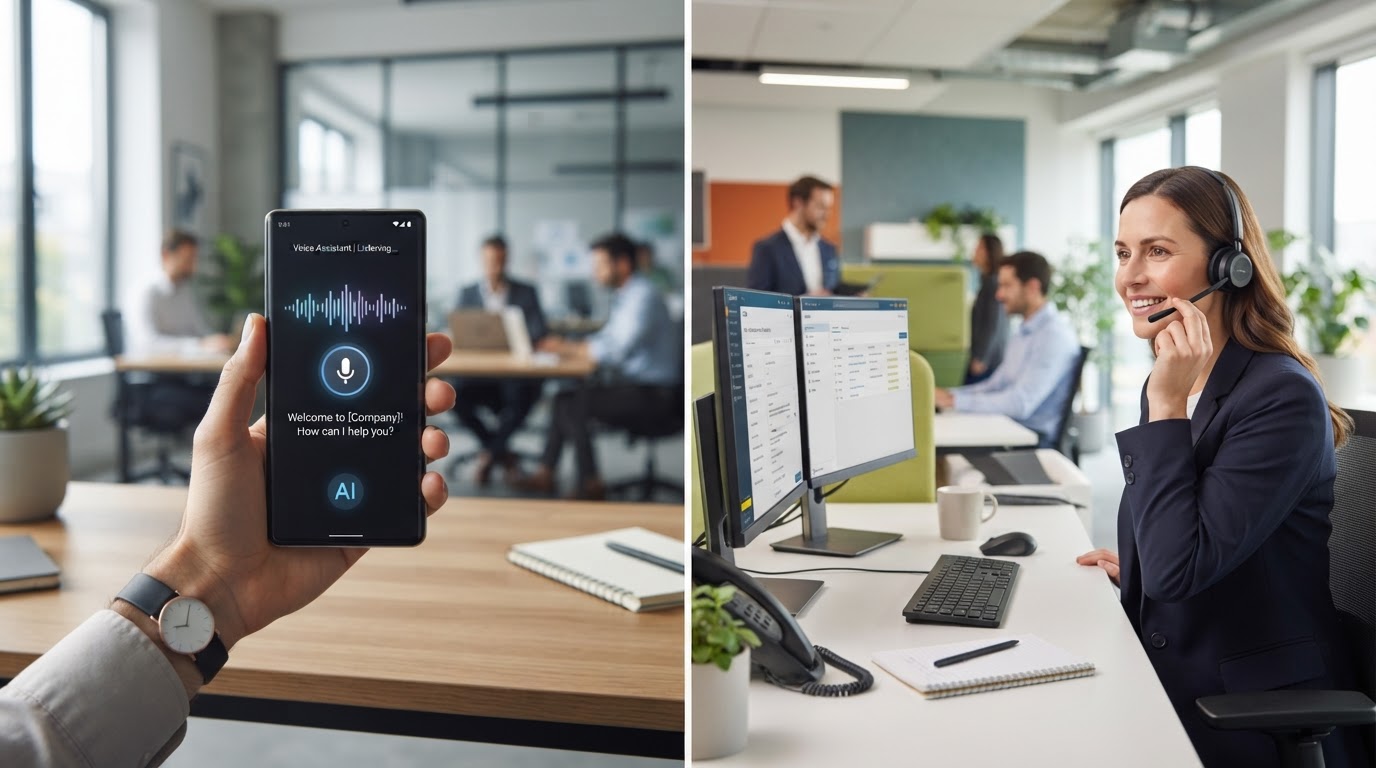
Quick Answer: AI Receptionist vs Outsourced Receptionist — Which Is Better?
There is no universal winner. An AI receptionist is better suited to businesses wanting 24/7 availability, predictable monthly costs, automated lead capture, instant appointment booking, and the ability to handle high call volumes without adding staff. An outsourced human receptionist is better suited to businesses where human empathy, judgement, and complex conversation handling are essential for most calls.
Many Australian service businesses are best served by a hybrid model: AI answers every call instantly, handles routine enquiries and bookings, and transfers complex or sensitive conversations to a human receptionist or staff member. This gives you 24/7 coverage and the human touch where it matters most.
What Is an AI Receptionist?
An AI receptionist is a voice-based artificial intelligence system that answers inbound business phone calls, greets the caller by your business name, and conducts a natural conversation. It is trained on your specific business knowledge base — services, pricing, hours, service areas, FAQs, and booking rules — and can answer common questions, qualify leads, capture caller information, and book appointments directly into your calendar.
Modern AI receptionists like Hailey speak with a natural Australian accent, understand local terminology and suburb names, and can transfer urgent calls to your mobile or on-call staff. They work 24/7, handle unlimited simultaneous calls, and send instant SMS and email summaries after every conversation. Capabilities depend on the provider and how the AI is configured, but the core function is consistent: answer every call instantly and handle routine enquiries so your team does not have to.
What Is an Outsourced Receptionist?
An outsourced receptionist is a human receptionist employed by an external call answering service who handles your business calls on your behalf. These services range from basic message-taking services to dedicated virtual receptionists who answer in your business name, book appointments, and manage enquiries.
Outsourced reception services vary significantly. Some operate during business hours only, others offer extended or 24/7 coverage. Some provide dedicated receptionists who learn your business, while others use shared pool staffing where different agents handle your calls. Pricing models include per-call, per-minute, monthly packages with included minutes, and dedicated receptionist arrangements. The level of customisation, integration, and call handling quality varies widely between providers.
Head-to-Head Comparison: AI Receptionist vs Outsourced Receptionist
Here is a detailed factor-by-factor comparison to help you evaluate which option fits your business:
| Factor | AI Receptionist | Outsourced Receptionist |
|---|---|---|
| Availability | 24/7/365 including public holidays | Business hours standard; 24/7 available at premium pricing |
| Cost structure | Flat monthly ($199–$499/mo) | Base + per-minute overages ($300–$1,200+/mo) |
| Human interaction | Conversational AI, not human | Real human on every call |
| Call volume | Unlimited simultaneous calls | Limited by agent availability; callers may queue |
| After-hours support | Included at no extra cost | Often attracts night/weekend surcharges |
| Lead capture | Structured, consistent, instant CRM sync | Manual message-taking; varies by agent |
| Appointment booking | Direct live calendar sync | Limited; depends on provider software |
| Call transfers | Instant transfer to mobile/on-call staff | Available but depends on provider workflow |
| CRM integration | Direct API sync, automated | Limited; often manual entry required |
| Scalability | Handles spikes instantly, no extra cost | Requires larger packages; may queue |
| Consistency | Same quality every call | Varies by agent experience and mood |
| Setup | Days (managed) or self-service | 1–3 business days onboarding |
| Ongoing management | Minimal; updates via dashboard | Requires regular briefings with provider |
| Customisation | Full knowledge base, voice, call flow | Scripted; changes require provider coordination |
| Complex conversations | Routes to human when needed | Handles nuance, empathy, judgement |
Cost Comparison: AI vs Outsourced Receptionist in Australia
Cost is one of the biggest factors for Australian business owners. The two models differ fundamentally in how they charge — and the cheapest advertised price is rarely the cheapest total cost.
AI receptionist pricing in Australia typically uses a flat monthly subscription model. Entry-level self-service plans start around $25–$65/month for limited minutes, standard small-business plans range from $99–$299/month for 200–500 included minutes, and flat-rate unlimited plans range from $199–$499/month with no per-minute overages. Managed implementations with custom setup may charge a one-off setup fee of $150–$1,500.
Outsourced receptionist pricing in Australia typically uses a base monthly fee plus per-minute or per-call charges. Basic plans start around $120–$200/month for a small number of included calls, with per-minute overages of $2.50–$3.50/minute once the allowance is exceeded. Dedicated virtual receptionist services range from $400–$1,200+/month. A busy month with 300 minutes of calls can easily generate an invoice of $900–$1,400 from a traditional answering service.
Total Cost of Ownership: Why the Headline Price Misleads
Businesses should compare total cost of ownership, not just the monthly subscription. The real monthly cost includes:
- Monthly base fee
- Per-minute or per-call usage charges
- Setup or onboarding fees (amortised)
- Phone number hosting costs
- SMS notification charges
- CRM or calendar integration fees
- After-hours or weekend surcharges
- Support or account management fees
Hypothetical Cost Example: 250 Calls per Month
Consider an Australian dental clinic receiving approximately 250 inbound calls per month, with an average call duration of 2 minutes (500 total minutes).
• AI Receptionist (Flat-Rate Unlimited at $299/month): Total monthly cost = $299. No overages, no surprises, 24/7 coverage included.
• Outsourced Receptionist (Base $200/month + 100 included minutes, $3.00/minute overage): $200 + (400 extra minutes × $3.00) = $1,400/month. After-hours surcharges may add another $200–$400.
• In this example, the AI receptionist costs approximately 80% less per month while providing 24/7 coverage the outsourced service does not include.
This is a hypothetical example for illustration only. Actual costs vary by provider, call volume, and plan inclusions.
Availability: 24/7 vs Business Hours
AI receptionists answer calls 24 hours a day, 7 days a week, 365 days a year — including weekends and public holidays — at no additional cost. There is no shift scheduling, no staff shortages, and no after-hours surcharges. Every call is answered on the first ring, day or night.
Outsourced receptionists typically operate during business hours (8am–6pm). Extended hours and 24/7 coverage are available from some providers, but these attract significant premium surcharges — often 50–100% above standard rates. During peak periods or staff shortages, callers may be placed in a queue or sent to voicemail.
For trades, clinics, beauty salons, and home services where after-hours enquiries are common, 24/7 availability is often the deciding factor. The caller with a burst pipe at 9pm or a toothache on a Sunday is not going to wait until Monday morning — they will call the next business that answers.
Customer Experience: AI vs Human Interaction
This is where the comparison gets nuanced. AI receptionists provide instant response, consistent information, and conversational interaction every single time. There is no variability in quality, no bad days, and no hold music. Callers get the same professional experience at 2am as they do at 2pm.
Human receptionists provide natural empathy, judgement, and the ability to interpret complex or unusual requests. A skilled human can pick up on tone, sense frustration, and adapt their approach in ways AI cannot. For sensitive conversations — complaints, anxious patients, complex enquiries — human interaction remains valuable.
The honest assessment: AI is not always indistinguishable from a human. For routine calls (80% of most businesses' inbound enquiries), AI delivers a faster, more consistent experience. For the 20% of calls that require empathy or complex problem-solving, a human receptionist or staff member is still the better choice. This is why a hybrid model often works best.
Complex Calls: Where Humans Still Have the Edge
Humans remain better at handling:
- Complaints and frustrated customers requiring de-escalation
- Sensitive conversations (medical results, billing disputes, legal matters)
- Complex technical issues requiring judgement and interpretation
- Unusual requests outside standard business workflows
- Negotiations or situations requiring real-time decision-making
- Calls where the customer explicitly needs reassurance or empathy
Routine Calls: Where AI Excels
AI handles routine enquiries faster and more consistently than humans:
- "What are your opening hours?"
- "Do you have availability this week?"
- "How much does a [service] cost?"
- "Where are you located?"
- "Can I book an appointment?"
- "Do you offer [service]?"
- New patient/customer enquiry capture (name, phone, address, service needed)
- Lead qualification (urgency, location, preferred time)
After-Hours Calls: The Hidden Revenue Opportunity
After-hours calls are often the highest-intent enquiries your business receives. A homeowner with a burst pipe at 9pm, a patient with toothache on a Sunday, or a potential client researching services after work — these are people ready to book. If your phone goes to voicemail after hours, 85% of them will simply call the next business on Google.
AI receptionists capture every after-hours call at no additional cost. Outsourced receptionists can provide after-hours coverage, but it typically attracts premium surcharges of 50–100%. For businesses in trades, healthcare, beauty, and home services, after-hours enquiry capture often pays for the entire monthly cost of an AI receptionist within the first week.
Appointment Booking: Direct Calendar Sync vs Message Taking
AI receptionists integrate directly with your calendar or practice management software (Google Calendar, Outlook, Cliniko, ServiceM8, Halaxy, and others). During the call, the AI checks live availability, offers open slots, and confirms the booking instantly. The caller hangs up with a confirmed appointment — no callback required.
Outsourced receptionists typically take a message and forward it to your team for manual booking. Some providers offer limited calendar integration, but this depends on the provider's software and your booking system. The result is often a delay between the call and the confirmed appointment, during which the caller may book elsewhere.
Lead Qualification: Structured Data vs Manual Notes
AI receptionists collect structured information consistently on every call: name, phone number, email, service required, location, preferred appointment time, urgency, and project details. This data is pushed directly into your CRM or sent via instant SMS and email — formatted and ready to action.
Human receptionists can ask more nuanced follow-up questions and adapt their approach based on the conversation, but the quality and consistency of lead capture varies by agent. Notes may be incomplete, inconsistent, or require manual data entry into your CRM.
Scalability: What Happens When Call Volume Spikes?
AI receptionists handle unlimited simultaneous calls. If a storm hits and 20 people call your plumbing business at once, the AI answers all 20 instantly — no hold music, no queue, no missed calls. There is no need to add staff shifts or upgrade your plan.
Outsourced receptionists are limited by agent availability. During call spikes, callers may be placed in a queue, sent to voicemail, or experience longer wait times. Scaling up requires purchasing larger call packages or adding dedicated staff, which increases monthly costs and takes time to arrange.
Integrations and Automation
AI receptionists connect directly with your business systems: CRM, calendar, booking software, SMS, website chatbot, review management, and lead management tools. Every call can trigger automated workflows — instant SMS follow-ups, CRM record creation, appointment reminders, and review requests — without any human intervention.
Outsourced receptionists may use software integrations, but the level of automation depends on the provider. Many still rely on manual message-taking and email forwarding, requiring your team to re-enter data and follow up manually. The depth of CRM integration varies significantly between answering services.
When an AI Receptionist Makes Sense
An AI receptionist may be the right choice if your business:
- Misses calls during busy periods, jobs, or after hours
- Receives repetitive enquiries (hours, pricing, availability, location)
- Wants 24/7 coverage without paying premium surcharges
- Wants automated lead capture pushed directly into a CRM
- Wants instant appointment booking with live calendar sync
- Prefers predictable monthly costs without per-minute overages
- Has limited reception resources or no dedicated receptionist
- Wants to scale call handling without adding staff
When an Outsourced Receptionist Makes Sense
An outsourced receptionist may be the better choice if your business:
- Requires human interaction for most or all calls
- Receives highly complex enquiries needing judgement and nuance
- Handles sensitive customer conversations (legal, medical, financial)
- Values human empathy and relationship-building on every call
- Wants an external team to fully manage call handling
- Has call volume too low to justify AI setup but needs human coverage
When a Hybrid Model Makes the Most Sense
For most Australian service businesses, the best solution is neither pure AI nor pure outsourced — it is a hybrid model that combines the strengths of both.
Here is how it works: AI answers every call instantly, 24/7. It handles routine questions (hours, pricing, availability), captures lead information, and books appointments where supported. When a call requires human judgement — a complaint, a complex enquiry, a sensitive conversation — the AI transfers the call to your in-house team or an outsourced receptionist.
This gives you 24/7 coverage, instant response times, automated lead capture, and the human touch where it matters most. You are not choosing between AI and human — you are building a system where each handles what it does best.
Industry Examples: How Different Businesses Choose
Different Australian industries have different needs. Here is how the decision plays out across common sectors:
Tradies (Plumbers, Electricians, Builders)
Tradies are on the tools all day and cannot answer the phone. Most calls are routine: "Can you fix my hot water system?", "What are your call-out fees?", "Can you come out today?". An AI receptionist captures these enquiries, qualifies the job, and books it into the calendar while the tradie keeps working. Complex calls (major project quotes, difficult customers) can be transferred to the business owner's mobile. AI is the clear winner for most trade businesses.
Dental Practices
Dental clinics receive a mix of routine booking calls and sensitive patient conversations. AI handles appointment enquiries, new patient registrations, and FAQ answering. Sensitive matters (anxious patients, treatment concerns, billing disputes) are transferred to reception staff. A hybrid model works best — AI handles volume, humans handle care.
Hair Salons & Beauty
Salons receive appointment enquiries, availability checks, and pricing questions while stylists are with clients. AI handles booking, availability, and after-hours enquiries. Complex consultations (colour corrections, treatment advice) can be booked for a callback. AI is ideal for capturing after-hours bookings that would otherwise go to voicemail.
Pool Builders
Pool building enquiries are high-value and complex. AI qualifies initial enquiries (budget, timeline, location, pool type) and captures structured information before the sales team follows up. The sales conversation itself requires human expertise. AI handles lead capture; humans handle the sale.
Professional Services (Lawyers, Accountants)
Professional services firms receive new client enquiries that require careful qualification. AI captures initial enquiry details and routes appropriate calls to the right person. Complex legal or financial conversations require human expertise. A hybrid model — AI for intake, humans for advice — is the standard approach.
ROI: How to Evaluate the Decision
To decide between AI and an outsourced receptionist, evaluate these factors for your business:
- Total monthly call volume and average call duration
- Number of calls currently missed per week
- Average value of a new customer or job
- Percentage of calls that are routine vs complex
- After-hours enquiry volume and value
- Current monthly cost (staff, answering service, or lost revenue)
- Importance of instant appointment booking
- Need for CRM integration and automated workflows
Hypothetical ROI Example
An Australian electrical contractor receives 180 calls per month, misses approximately 25 calls per week while on site, and has an average job value of $450. Of those 25 missed calls, roughly 15 are new enquiries.
• If an AI receptionist captures just 6 of those 15 missed new enquiries per month, that represents $2,700 in recovered revenue.
• Subtracting a $299/month AI receptionist subscription results in a net positive return of $2,401 per month.
• An outsourced receptionist at $600/month (base + overages for 360 minutes) would need to capture 14 additional jobs just to break even.
This is a hypothetical example. Actual results depend on call volume, conversion rates, and average job value.
12 Questions to Ask Before Choosing
Before deciding between an AI receptionist and an outsourced receptionist, ask:
- 1. How many calls do we receive per month?
- 2. How many calls do we currently miss?
- 3. How complex are our calls (routine vs nuanced)?
- 4. Do we need after-hours or weekend support?
- 5. Do we need instant appointment booking?
- 6. Do we need CRM integration and automated workflows?
- 7. How important is human interaction for our callers?
- 8. What is our current monthly cost for call handling?
- 9. What happens when call volume spikes?
- 10. How quickly can we change or update call handling?
- 11. Can calls be transferred to humans when needed?
- 12. What is the total cost of ownership, including overages?
Final Verdict: Which Should You Choose?
There is no universal winner — but there is a clear framework for deciding.
Choose AI If...
- You miss calls during busy periods or after hours
- Most of your calls are routine (bookings, FAQs, pricing, availability)
- You want 24/7 coverage without premium surcharges
- You want predictable monthly costs with no per-minute overages
- You want automated lead capture and calendar booking
- You want to scale call handling without adding staff
Choose Outsourced Human Reception If...
- Most of your calls require human empathy, judgement, or nuance
- You handle sensitive conversations (medical, legal, financial)
- You value human relationship-building on every call
- Your call volume is low and predictable
- You want an external team to fully manage call handling
Consider Hybrid If...
- You receive a mix of routine and complex calls
- You want 24/7 coverage but still need human handling for specific call types
- You want to reduce reception workload without losing the human touch
- You want AI to handle volume and humans to handle complexity
Frequently Asked Questions
Is an AI receptionist cheaper than an outsourced receptionist?
In most cases, yes. AI receptionists in Australia cost $199–$499/month flat with no per-minute overages, while outsourced receptionist services typically cost $300–$1,200+/month once overage charges are included. For a business receiving 250+ calls per month, the AI receptionist can be 70–80% cheaper. However, for businesses with very low call volume, a basic outsourced plan may be comparable — always compare total cost of ownership, not just the headline price.
Is an outsourced receptionist better than AI?
It depends on your calls. If most of your calls require human empathy, judgement, or complex problem-solving, an outsourced receptionist may be better. If most of your calls are routine (bookings, FAQs, pricing, availability), AI provides faster, more consistent handling at a lower cost. Many businesses use a hybrid model — AI for volume, humans for complexity.
Can an AI receptionist transfer calls to a human?
Yes. AI receptionists like Hailey can instantly transfer calls to your mobile, on-call staff, or an outsourced receptionist when the conversation requires human handling. This means you never lose the human touch — AI handles routine calls and routes complex ones to the right person.
Can an AI receptionist book appointments?
Yes. AI receptionists integrate directly with Google Calendar, Outlook, Cliniko, ServiceM8, and other booking systems. During the call, the AI checks live availability, offers open slots, and confirms the booking instantly. Most outsourced receptionists take a message and forward it for manual booking, which creates a delay.
Can an outsourced receptionist answer calls 24/7?
Some outsourced providers offer 24/7 coverage, but it typically attracts premium surcharges of 50–100% above standard rates. AI receptionists include 24/7 coverage at no additional cost. For businesses with significant after-hours enquiry volume, this difference alone can justify choosing AI.
Which is better for small businesses?
For most small Australian service businesses, an AI receptionist offers better value: lower cost, 24/7 coverage, instant booking, and no per-minute overages. If your business handles sensitive or complex calls where human empathy is essential, consider a hybrid model or an outsourced receptionist for those specific call types.
Which is better for tradies?
AI is almost always the better choice for tradies. Tradespeople cannot answer the phone while on the tools, most calls are routine (job enquiries, pricing, availability), and after-hours emergency calls are high-value. An AI receptionist captures every call, qualifies the job, and books it into the calendar while the tradie keeps working — at a fraction of the cost of an outsourced service.
Can AI handle complex calls?
AI handles routine calls excellently but is not designed for complex, nuanced conversations requiring human judgement. For those calls, the AI takes a detailed message, collects contact information, and transfers the call to your team or an outsourced receptionist. This ensures complex matters receive human attention while routine calls are handled instantly.
Can AI and outsourced reception work together?
Absolutely. This is the hybrid model, and it is increasingly popular. AI answers every call instantly, handles routine enquiries and bookings, and transfers complex or sensitive calls to an outsourced receptionist or in-house staff. You get 24/7 coverage, instant response, automated lead capture, and human handling where it matters most.
What does an outsourced receptionist cost in Australia?
Outsourced receptionist services in Australia typically charge a base monthly fee ($120–$400) plus per-minute overages ($2.50–$3.50/minute). A business receiving 300 minutes of calls per month can expect to pay $600–$1,400 depending on the provider and plan. Dedicated virtual receptionist services range from $400–$1,200+/month.
What does an AI receptionist cost in Australia?
AI receptionists in Australia cost between $199–$499/month for flat-rate plans with 24/7 coverage and no per-minute overages. Entry-level self-service plans start at $25–$65/month for limited minutes. Managed implementations with custom setup may charge a one-off setup fee of $150–$1,500.
Is an AI receptionist worth it?
For most Australian service businesses, yes. If you miss calls, receive routine enquiries, or need after-hours coverage, an AI receptionist typically pays for itself within the first week by capturing 1–2 jobs that would have gone to a competitor. Calculate the value of your missed calls against the monthly cost to determine your ROI.
Related Articles
Hailey
Hailey AI — Australian AI Automation Team
Hailey is part of the Hailey AI team, helping Australian service businesses automate enquiries, bookings, and customer communication. With hands-on experience across trades, healthcare, and professional services, Hailey writes practical, no-fluff guides focused on real business outcomes.
Stop Losing Jobs to Missed Calls
Start your 7-day free trial today. No credit card, no lock-in contract. Includes your FREE AI website + AI Website Chatbot.